matthias kuhn/alex meszmer
das perfekte leben - fragmente einer anatomie menschlicher strategien
performativer vortrag
mittwoch, 1. oktober 2008, 19 uhr
kunstmuseum solothurn
werkhofstrasse 30, ch-4500 solothurn
matthias kuhn und alex meszmer präsentieren mit «das perfekte leben - fragmente einer anatomie menschlicher strategien» - nach «travelogue, suchen statt finden oder, wo sind wir wenn wir reisen» und «eine geografie des unerklärlichen» - den dritten teil der trilogie ihrer performativen vorträge und sezieren die menschliche physis, erforschen die menschliche psyche und suchen menschliche strategien in den weiten des sozialen lebens zu deuten. damit führt der letzte teil nach ausgedehnten reisen durch die welt und die galaxies ganz zum menschen zurück.
der vortrag führt wieder eine vielzahl von werken der literatur- und filmgeschichte zusammen, spielt songs der popgeschichte an und versucht nichts weniger, als alles zu einem feinen geflecht zusammenzubringen und zu verweben. dabei trifft der heilige gral ganz selbstverständlich auf heinz von förster und hildegard von bingen auf thomas bernhard ... und so führt der exkurs am schluss auch folgerichtig wieder an den anfang zurück, ins paradies und damit selbstverständlich zu den fragen nach dem glück und dem sinn des lebens.
http://www.wortwerk.ch
http://www.kunstmuseum-so.ch
MSB brainstorming

28 September 2008

25 September 2008
Brandl in Chicago and Champaign Art Museum, Soon!


Two invitations: SHARKPIT and KRANNERT ART MUSEUM.
I, Mark Staff Brandl, will be in the US in October and would love to see you -- and show you work. The dates and contact info ---
OPENING (vernissage, apero)
SHARKPIT (Wesley Kimler's Studio)
THURSDAY OCTOBER 16 from 7:30 - 11:00 pm (or so)
a small SHOW of littler works
After that a very large painting-installation in
KRANNERT ART MUSEUM
Champaign, Illinois
THURSDAY OCTOBER 23 from 6:00 - 8:00 pm
(Wherein I will also give a "gallery conversation")
YOU ARE INVITED! Please come to one or both.
More info ---
I will be in Chicago from Monday October 13th through morning of Friday October 17th.
I will be in Champaign, Illinois installing the piece(s) from Friday October 17th through the morning of Saturday October 25th, that day pm I will fly home to Zurich.
I will be staying at:
(In Chicago:)
Wesley Kimler's Studio
2046 W. Carroll
Chicago, IL USA 60612
Shark phone: 312 942-9078
(In Champaign:)
The Lindley House
312 W. Green St.
Urbana, IL 61801
384-4800
Phone: 217-384-4800
www.lindley.cc
I can be contacted through
Wesley Kimler 312 942-9078
Christine Saniat
Assistant Registrar
University of Illinois
Krannert Art Museum
500 E. Peabody Drive
Champaign, IL 61820
217.333.2570
or
Chris Schaede
Office Administrator
University of Illinois at Urbana-Champaign
Krannert Art Museum MC-592
500 E. Peabody Dr.
Champaign, IL 61820
217.244.0516
18 September 2008
Beat Kriemler Sculpture for New Orleans

(Image: Kriemler's Sculpture at the Olympics in China)
After 7 months of planning and preparation to participate in the international sculpture exhibition: Sculpture for New Orleans www.sculptureforneworleans.org , my monumental steel sculpture "Current" is since today on its way to the crescent city New Orleans. Together with second participating Swiss sculptor Carlo Bürgi, www.cabulart.ch we delivered our artwork to the port of Antwerpen last week.
The concept for the exhibition Sculpture for New Orleans is the brain child of New Orleans native sculptor Michael Manjarris. www.manjarris.com . After Hurricane Katharina demolitioned vast parts of the "Big Easy", leaving the city devasted and half deserted, Manjarris who now lives in Texas wanted to help bring back the spirit and the people to his former hometown. Together with friends and patrons, ranging from artists, buisness people, galleries, museums, private individuals and city officals, Sculpture for New Orleans came into being. Read indept article on the exhibition: PUBLIC TREASURE- NOLA.com . To support this idea as well as my practise I follow Michael's invitation and send my sculpture to New Orleans.
Since winter 2007, the 2 year sculpture program featuring many of the world's recognized sculptors, including Louise Burgeouis, Mark di Suvero, Alexander Calder and others, places arriving sculptures at a 3 to 5 week intervals. My sculpture "Current" is expected to arrive in New Orleans October 17. 2008. As I keep you updated.
All the Best to you, Beat Kriemler
Liebe Freunde der Skulptur
Nach 7 Monaten der Plannung und Vorbereitung für die Teilnahme an der internationalen Skulpturen Ausstellung Sculpture for New Orleans www.sculptureforneworleans.org, habe ich letzten Freitag zusammen mit Carlo Bürgi, www.cabulart.ch zweiter an der Ausstellung teilnehmender Schweizer Bildhauer, meine Grossplastik "Current" zum Antwerpener Hafen gebracht. Seit heute sind unser Kunstwerke unterwegs nach New Orleans.
Konzeptualisert hat die Ausstellung der in New Orleans geborene und aufgewachsene Bildhauer Michael Manjarris. www.manjarris.com . Nachdem Hurricane Katharina New Orleans verwüstet und entvölkert hatte wollte Manjarris etwas dazu beitragen den Stolz, die Lebensfreude, und die Menschen zurück in seine ehemalige Heimatstadt zu bringen.
Zusammen mit Freunden, Mäzenen und Gönnern, die von Künstlern, Geschäftsleuten, Galerien, Museen, bis zu Privatleuten und Stadtvertretern reichen, rief der heute in Texas lebende Manjarris Sculpture for New Orleans ins Leben. Lesen Sie einen Presse Bericht in Englisch dazu PUBLIC TREASURE- NOLA.com . Aus diesem Grund, aber auch um meine künstlerische Karriere voranzubringen folge ich Michael's Einladung und schicke meine Stahl-Plastik "Current" nach New Orleans. Seit dem Winter letztes Jahres werden im Abstand von 3 - 5 Wochen die ankommenden Skulpturen international bekannter Künstler wie: Louise Burgeouis, Mark di Suvero, Alexander Calder und Anderer in der Innenstadt von New Orleans aufgebaut. Meine Plastik wird um den 17 Oktober 2008 erwartet. ich halte Sie wie auf dem Laufenden.
mit freundlichen Grüssen,
Beat Kriemler
Sculptor
Postfach 59
CH 9213 Hauptwil
Switzerland
++41 71422 11 05
www.beatkriemler.com
27 August 2008
James Kalm: Jonathan Lasker
A video report on Jonathan Lasker's recent paintings at Cheim & Read Gallery, Chelsea.
04 August 2008

31 July 2008
Art Basel & UBS Come Under IRS & Senate Investigation

The United States Tax Authority IRS (Steuerbehörde) has asked the Swiss government to aid in the investigation of International Banking & Investment group UBS and their overseas tax havens programs which some have reported amount to intentional tax evasion and fraud.
Art Basel is mentioned as the go to location for foreign employees of UBS to illegally recruit wealthy individuals to help them avoid reporting billions of US dollars in assets. Clients were at times told to use code words when communicating with UBS. Testimony states that roughly 80 UBS bankers traveled to the US 4-6 times a year to pitch the bank’s secretive services to clients at upscale events as Miami’s annual Art Basel fair.
The bankers used encrypted computers, devised codes for their clients’ identities, told Customs agents the trips were for vacations, notbusiness, and advised clients to place jewelry, paintings and other assets in Swiss safe deposit boxes, Birkenfeld testified in June, when he pleaded guilty to helping California billionaire Igor Olenicoff evade $7.2 million in U.S. taxes.
Former LGT computer technician Heinrich Kieber helped tax investigators around the world flesh out those statistics by handing over data on approximately 1,400 of the bank’s clients.
Kieber is in hiding as Liechtenstein authorities seek him on charges of violating secrecy laws.
06 July 2008
Interview with Mark Staff Brandl at myartspace>blog

Brian Sherwin, artist and art blogger has interviewed me, the EuroShark for his website, myartspace>blog. Sherwin, originally from Illinois and now living in California, has conducted and published a series of interviews with visual artists including William T. Wiley and others. You can read his piece with me here.
17 June 2008
Brandl and El Farra: Basel Art Fair Radio Podcast

A Bad at Sports Basel Art Fair Overdose!
The intro and outro are extra creepy this week. Highlights(?) include Duncan talking about some fantasy involving wearing tight short shorts and Teena McClelland!!! Tom Burtonwood interrupts the recording by shooting rubber bands. Chaos!
After Richard and Duncan are done making a mess of things, the real pros come in and present a fantastic report from Basel.
Lamis El Farra, emerging artist, and the EuroShark Mark Staff Brandl, seemingly perennially emerging black sheep artist, traverse and discuss the entirety of the King of Art Fairs, Art Basel. Yes: the Fair Itself, Art Statements, Art Unlimited, Scope, and the Solo Project. They only missed Liste and Print Basel. Sorry, but all the rest was already enough. Of course they were at the VIP opening (ahem) and managed to talk to more people than you can shake a stick at: artists, gallerists, museum directors, curators, critics, art magazine editors, fair organizers, all the hangers-on, …er…, important elements of the international artworld.
Link: http://badatsports.com/2008/episode-146-art-basel/
Gerhard Mack
NZZ
Herzog and de Meuron
Schaulager Basel
Andrea Zittel and Monika Sosnowska
Vitra Design Museum
Rem Koolhaas
Basel Art Statements
Basel Art Unlimited
Marc Spiegler
Thomas Hirschhorn
Roland Waespe
Kunstmuseum St. Gallen
Udo Kittelman
The Rolf Ricke Collection
Dave Muller
Three Day Weekend
Florian Berktold
Hauser and Wirth
Mary Heilmann
Subodha Gupta
Dan Graham
Pippilotti Rist
Christoph Buechel
Tony Wuetrich
Hanspeter Hofmann
Leiko Ikemura
Leonard Bullock
Florian Suessmayr
Leipziger Schule
Neo Rauch
Boers-Li Gallery
Qiu Xiaofei
Alex Meszmer / Reto Mueller (Zeitgarten)
Elizabeth C. Baker
Art in America
Chaim Soutine
Museum fuer Gegenwartskunst Basel
Kunsthaus Zurich
Ferdinand Leger
Museum Tinguely
Gary Justis
Marcia Vetrocq
Glen O’Brien
Raphael Rubinstein
Interview magazine
The Magazine Antiques
Artforum
Museum der bildenden Kuenste Leipzig
Gunther Sachs
Berlin Biennale
Faye Hirsch
Sharkforum
ArtNews
Ellsworth Kelly
David Zwirner Gallery
Greg Kwiatek
Paul Bloodgood
Galerie Karin Sutter
Beyeler Gallery
Next Fair
David Reed
Erik Colan
Wesley Kimler
Scope Art Fair
Emma Biggs and Matthew Collings
Carrie Secrist Gallery
Loreen Hospodar
Kelly Chen
Art Chicago
Petroc Sesti
Robert Standish
Römerapotheke Galerie Zurisch
Philippe Rey
Filiale Galerie Berlin
Vera Ida Mueller
Solo Project
Stephanie Sherga
Hans Gieles
Vous Etes Ici Gallery Amsterdam
Martijn Schuppers
Olivier Houg Galerie Lyon
Mathias Schmied
16 June 2008
Death of the artist (again)

http://belcheresque.wordpress.com
Freedom's just another word for nothing left to loose
Nothing, I mean nothing honey if it ain't free, no no
Yeah feeling good was easy Lord when he sang the blues
You know feeling good was good enough for me
Good enough for me and my Bobby McGee.
Kris Kristofferson 'Me and Bobby McGhee' Lyrics
A money culture wants the figures, the bottom line, the sales, the response, it wants a return on its investment, it wants more money.
Art can offer no obvious return. Its rate of exchange is energy, for energy, intensity for intensity. The time you spend on art is the time it spends with you; there are no short cuts, no crash courses, no fast tracks. There is only the experience.
Jeanette Winterson - ‘What is art for?’ - Guardian 2002
Where are we now? - the bigger picture
Arts planning and funding in the U.K. has been thrown into turmoil by two or three concurrent factors. One a slowdown (pace - 'recession') globally which may well remove the Labour Party from power in the next two years.
Two a diversion of a significant amount of lottery funding to the Olympics (even if there were no Olympics to pay for the income from lottery is in a downward spiral).
Thirdly a cut-throat bottom-line cash-driven business model in arts education that is pumping out a hundred fine art graduates per institution into the muddy waters of U.K. Creative Industries PLC. Even the most hard-nosed ACE administrator realises that the gravy will be spread thinner and thinner soon on some very poor fare...
Where are all these new 'geniuses' going to go?
'Free Enterprise'?
So here I am 50 years old and advocating 'Freemium' policies, freecycle marketing and not-for-profit artists organisation and pressure-groups. I must, therefore, be mad?
I honestly believe this is the only sensible way forward...the arts council's golden goose has probably laid its last golden eggs for a while in terms of low-end funding..
For new models perhaps we should look to American free enterprise models that are not based on 'state funding'. We need enterprise, imagination and communal enterprise to survive this recession.
Nottingham was the base for the East Midlands Group in the 1970's that survived and prospered because all of those things..not just because it was state-funded. It high time that artists stopped 'competing' like so many little businesses for government 'largesse' and actually started producing high quality work people actually might want to take an interest in.
This starts with reskilling our fine arts graduates instead of spilling them out with pretentious notions and badly conceived ideas of being the next Damien Hirst or Tracey Emin. Removing the skills base was one of the tragedies of the past two decades of art education.
GLOBAL/LOCAL?? Digital freedom?
The free market is dominant to a degree we have never seen before and it destroying not only local communities but the old 'communla' bonds between creative individuals. Grants and lip-service cannot change the digital wrecking ball creating havoc with creative copyright. Protecting one's work digitally is impossible. All creative output can be copied and distributed freely...those who do not accept this are swimming against a very strong tide.
The only 'saleable' commodity left to the artist is his/her own ideas and experience and the 'authenticity' of thenpersonal appearances..or substitute appearances in shows etc. Crafts practitioners are strong on the 'authentic and personal' properties that sell items but fine artists no longer are because of recent changes in fashion. To have abandoned traditional skills just at the point where they are most needed is madness. I call this kind of art and skills based production 'slow art' to differentiate from the internet's dissemination of 'fast food art'. This 'fast art' is eroding the market for all the arts...
A 'near-perfect' copy of a Francis Bacon can be painted in China in the time I have taken to write this evaluation ....so why bother being Francis Bacon any more the students argue..we have ideas...such wonderful ideas....Indeed all 100 have wonderful ideas..it is putting them into 'practice' literally that requires skills and understanding as well as ideas.
Some digital artists are already 'outsourcing' their creative output to others on a massive scale..just like companies.
It began with YBA's (Hirst and co. had most 'artifacts' 'made-up' for them) now everyone's doing it...especially those students coached early in their career in networking and the 'wow factor'.
Students are no longer taught to make paints or stretch a canvas or cast bronze ..we have entered a period of 'Warholian' education.
True 'authenticity' is in short supply now and Fordism is a more relevant philosphy to artists now than the 'Van Gogh' suffer and paint model..ironically both he and Picasso engaged in bartering - swapping paintings for food and drink when poor....plus ca change....
Everything else in the arts has been up for grabs since the internet was invented.
To paraphrase Kris Kristofferson in 'Me and Bobby McGhee'.....
Freedom's just another word for nothing left to sell.
Nothing ain't worth nothing less it's free
We are all living in the freemium economy.
13 June 2008
Moogee in Baltimore..
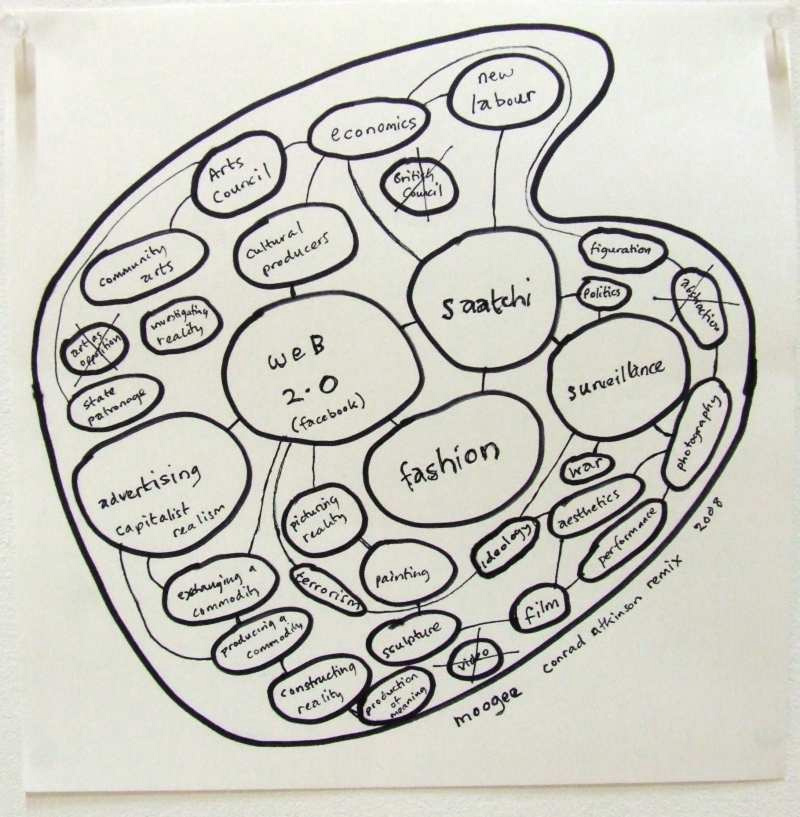
‘Conrad Atkinson Remix 1978-2008′ by Moogee the Art Dog
has been selected for ‘Penned’
at the Pinkard Gallery, Bunting Center, Maryland Institute College of Art, Baltimore
An exhibition of pen and/or marker drawings including photographs of the pens used to make them. The more than 100 drawings in this exhibition cover a broad range of pens from the generic ball point to the traditional rapid-o-graph and feather quill to the modern array of jell and artists’ pens.
This exhibition will travel to Ellipse Arts Center, Arlington, VA and Lump Gallery/Projects, Raleigh, NC and possible other galleries in the coming years.
27 May 2008
Trailer Star on Songs Illinois Music Blog

Well respected music blog features Trailer Star album...
Songs Illinois
New song/record from Ron Sexsmith - “Exit Strategy For The Soul” (Yep Roc, July 8) (plus Trailer Star from England)May 21st, 2008
I’m always talking the talk about over-produced records and how something lofi is usually ultimately more satisfying. Well today we walk the walk with the new record from Trailer Star aka Shaun Belcher. This arrived unannounced in my inbox by way of England. Shaun Belcher is a singer songwriter along the lines of our own Jim White. That means he’s concerned with sin and salvation and creates folk music that has a southern gothic feel to it. To go along with the music Shaun creates original artwork that is clearly influenced by the folk art of the deep south. Here’s his song “Firework Factory” and the artwork that goes with it.Suit of Nettles is the new record and the limited edition cd can be purchased from the trailerstar records website.
http://trailerstarrecords.blogspot.com/
25 May 2008
Art Radio Podcast from Corinne Schatz's Birthday Party

This weeksBAD AT SPORTS art-radio podcast show from the US is as long as your arm and brimming with what you need to know about the art world around you…
It’s a three shows for the price of one deal!!!
First Duncan takes on the Chicago Artist Coalition to find out, what they do and
what business they have publishing a magazine.
Next,Terri and Serena talk to David Adjaye and Cydney Payton at The Museum of Contemporary Art: Denver
and figure out how you go about building a museum.
As if that was not enough, Mark Staff Brandl our European Chief checks in to remind us
how important it is to be a member of a community.
Corinne Schatz.
Much of the regional art scene, from famous to lesser well-known was
there. Brandl ambushes and steamrolls many of them into making
off-the-cuff comments about Corinne, something Swiss people absolutely
hate. They prefer to brood over answers for a long time, making
certain they are not stepping on any feet. Fortunately, almost
everyone here played along good-naturedly, even if no one answered the
million-dollar question, “Why should Corinne write a huge damn
monograph about you and your art?” Look for serious interviews with
many of these artists in the future, so let this serve as a
superficial introduction.
Link: http://badatsports.com/2008/episode-142three-for-one/
Names dropped and Interviewees include:
Corinne Schatz
Marianne Schatz
Marlis Pekarek
Josef Felix Mueller
Urs Eberli
Clemens Mueller
Rachel Lumsden
Elisabeth Nembrini
Elisabeth Keller-Schweizer
Ursula Badrutt Schoch
Guido
23 May 2008
Post-Event Artworld Arising (Slowly?); C. Knight on Matthew Barney's 'REN'

Finally, an important critic takes a clear stance on "Event Art." Will the Consensus Curatorial World that feeds on such events be analyzed soon too?
Christopher Knight of the LA Times dissected Matthew Barney's 'REN' in a recent article.
"Cliches Abound"
"The first mistake Matthew Barney made in his corny two-hour performance, "REN," at a Santa Fe Springs car lot Sunday night, was in the choice of starring automobile. The 1967 Chrysler Imperial had obvious meanings.
The year is the artist's birth date. The make is Manhattan's iconic skyscraper, a star of Barney's five-part film, "The Cremaster Cycle." Lastly, the journey from Vietnam to Iraq in America's imperialist adventures abroad was spelled out on the car's front grille.
It was that kind of night. Clichés were practically announced via bullhorn to several hundred invitation-only guests. So provincial was the vision of the West that a better headline star would have been a 1967 Chrysler New Yorker. "
...
"Consider the interminable event over not on the day the troops come home from Baghdad or a replacement for a petroleum-based economy is found, but on the night the Chrysler Imperial's car hood shows up on the turntable at Christie's auction house."
Read the rest here
14 May 2008
Robert Rauschenberg Passes Away


Michael Kimmelman of The New York Times reports that "Robert Rauschenberg, the irrepressibly prolific American artist who time and again reshaped art in the 20th century, died on Monday night at his home on Captiva Island, Fla. He was 82.
The cause was heart failure, said Arne Glimcher, chairman of PaceWildenstein, the Manhattan gallery that represents Mr. Rauschenberg.
Mr. Rauschenberg's work gave new meaning to sculpture. "Canyon," for instance, consisted of a stuffed bald eagle attached to a canvas. "Monogram" was a stuffed goat girdled by a tire atop a painted panel. "Bed" entailed a quilt, sheet and pillow, slathered with paint, as if soaked in blood, framed on the wall. All became icons of postwar modernism.
A painter, photographer, printmaker, choreographer, onstage performer, set designer and, in later years, even a composer, Mr. Rauschenberg defied the traditional idea that an artist stick to one medium or style. He pushed, prodded and sometimes reconceived all the mediums in which he worked.
Building on the legacies of Marcel Duchamp, Kurt Schwitters, Joseph Cornell and others, he helped obscure the lines between painting and sculpture, painting and photography, photography and printmaking, sculpture and photography, sculpture and dance, sculpture and technology, technology and performance art -- not to mention between art and life.
Mr. Rauschenberg was also instrumental in pushing American art onward from Abstract Expressionism, the dominant movement when he emerged, during the early 1950s. He became a transformative link between artists like Jackson Pollock and Willem de Kooning and those who came next, artists identified with Pop, Conceptualism, Happenings, Process Art and other new kinds of art in which he played a signal role.
No American artist, Jasper Johns once said, invented more than Mr. Rauschenberg. Mr. Johns, John Cage, Merce Cunningham and Mr. Rauschenberg, without sharing exactly the same point of view, collectively defined this new era of experimentation in American culture."
Continue reading the article here.
02 May 2008
Brandl: Meeting Joe Fyfe at Felix Lehner’s Casting Foundary

Joe Fyfe painting

Felix Lehner and Hans Josephsohn
I've been meaning to write about this for some time, but kept getting sidetracked by other events. Last summer, I met the very interesting painter and "writer on art" Joe Fyfe.
Unfortunately I was in the throes of completing my three years of learning Latin and preparing for and taking the day-long final examinations, as well as painting for a couple of shows and teaching. Thus, I didn't get more than one real meeting with him, visiting him at the studio where he was staying and having lunch in the restaurant surrounded by the Pipilotti Rist's "Kunst am Bau," a giant red outdoor lounge. I agree with what Joe said, that it is not a metaphor that really attracts me. It was gutsy of the city to pay for and install it (most Kunst am Bau is rather flaccid, decorative geometric nonsense or quasi-event neo-conceptual entertainment novelties). Nevertheless, it doesn't hold together well and is ageing quickly and poorly.
Fyfe was doing a visiting artist/scholar residency at Felix Lehner's wonderful fine art casting foundry, a place I should hype more. St. Gallen, Switzerland is fortunate to have two of the world's best artisans-serving-fine art: Urban Stoob, a famous and remarkable stone lithographer about whom I'll write another time, and Felix Lehner.
In the Sitter river valley, a small yet dramatic drop from the surrounding area, west of the city, an industrial (more formerly than now) area is located. Here, a former textile dyeing factory was converted by Lehner into a foundry. Within 10 years it had international renown. Over a dozen expert artisans assist artists in the production of sculptural works as well as occasionally restoring important historical bronzes. And generally of very large proportions.
Felix Lehner, the founder and boss of the foundry is highly knowledgeable of contemporary art. Furthermore, he is the initiator of the "Sitterwerk" a permanent conglomeration of a handful of buildings forming a private art center (link), including a monographic museum, Schaulager and library. One area is dedicated primarily to Hans Josephsohn, a unique sculptor who you should google. The Sitterwerk and Foundary's website in English is here. The site for the Josephsohn museum, situated in the former boilerhouse, hence called the Kesselhaus, is here.
Fyfe, besides painting his own works, was there to research and rewrite an essay for Art in America on Hans Josephsohn. Fyfe had just returned from an extended stay in Southeast Asia, which he blogged about here.
Joe is, in fact, a fine and inveterate blogger. You can check in on him here, where, under July 18th, he wrote about our meeting.
Fyfe does some highly unique artworks wherein I see shades of Blinky Palermo cavorting with the soul of Matisse. Generally described, he stitches and glues found fabric together, abutting the elements rather than collaging them, and then applies very sparse strokes of paint. Very atmospheric, clear-sighted, elegant and historically aware. His writing is similar. Some bio minutiae: Fyfe was born in NYC in 1952, received his BFA from the University of the Arts in 1976. He has had recent solo shows of his paintings at JG Contemporary in New York City, and at Mai's Gallery in Ho Chi Minh City, Vietnam. He has been in recent shows at Tracy Williams Ltd. and Cheim and Read in NYC, Galerie Pitch in Paris and The Myers School of Art in Akron, Ohio. He has taught at Parsons, VCU, Temple and UT, Knoxville. He has received grants from The Pollock-Krasner and Gottlieb Foundations and he writes for Gay City News, Art in America, Arts AsiaPacific, Art on Paper and Artcritical.com.
You can read articles by Fyfe at artcritical here.
A fine interview with Joe and Merlin James titled "This Wonderful Exile of the Artist" was in Modern Painters (no kidding! A painter interviewed in Modern Painters!). It is available on the web here.
A review of Fyfe's paintings by Stephen Maine, originally in Art in America, is available here.
And while we are listing links, Fyfe is represented primarily by JG Contemporary, website here.
I felt an immediate affinity with Joe, and a similarity of perception, strangely enough, as our individual aesthetics are superficially so different. I would have liked to talk longer and repeatedly with him. Well, another time!
21 April 2008
Brandl: Meta-Toons, Details O' De Tales
A series of four abstract cartoons by artist Mark Staff Brandl, originally made in 2001, in collaboration with Mustafa Kocabeyoglu. Now available on youtube.
15 April 2008
Meszmer: Verbrannte Erde

Duchamp, Beuys und Warhol – das sind meiner Meinung nach die drei Künstler, die im 20. Jh. in der Kunst den Weg bestimmt haben – oder das meiste angerichtet. Duchamp hat mit seinen ready mades die Möglichkeit zur konzeptuellen Arbeit eingeleitet, Beuys hat mit gesellschaftlichen Utopien experimentiert, die er in einfachen Analogien ausgedrückt hat und Warhol hat den Konsum und das Jetzt zur Kunst erklärt.
Allen Dreien gemein ist die Vorstellung vom Künstler als abgehobener oder besserer Mensch, der in seiner Aussensicht die Gesellschaft verändern kann. Wie bewusst dies durch Duchamp geschehen ist, wage ich manchmal zu bezweifeln; Beuys sah sich sicher in erster Linie in einem weltverbesserndern Zusammenhang, Warhol erklärte gleich das Geschehen an sich zur Kunst – so einfach kann man es sich machen. Alle drei haben auf ihre Art eine Politik der verbrannten Erde betrieben und es durch ihre Arbeit den nachfolgenden Künstlern erschwert zu agieren.
Seit der Moderne sieht sich der Künstler als autonomer Mensch, der aus sich heraus seine Werke produziert. Er ist und bleibt nur sich alleine und seinem Werk Rechenschaft schuldig und vereinnahmt eine Position, die innerhalb einer autoritär strukturierten Gesellschaft, wie wir sie noch Ende des 19 Jh. vorfinden, die einzig mögliche ist: Im Elfenbeinturm kann der Künstler (die Damen vergeben mit bitte, dass ich nicht immer die weibliche Form mitführe) durch seine konsequente Abgrenzung von der Gesellschaft als Avantgardist bestehen und auf die Schwachpunkte aufmerksam machen. Als moderne Kassandra treten Künstler politisch auf und weisen auf widrige Umstände hin – nur, kann das die einzige Motivation für Kunst sein?
Zugleich mit der Autonomie sieht sich der Künstler verstärkt vor Überlebensprobleme gestellt, denn welcher Staat hält sich einen Hof an Kritikern, die immer sogleich zur Stelle sind um über Missstände zu berichten?
Die Künstler werden so zu selbsterklärten Outkasts der Gesellschaft, die unverstanden vor sich hinvegetieren, bis ihre vorausschauende Weltsicht erkannt wird. Sie müssen sich absondern und mit der Vereinzelung der Künstler wird auch ihr Horizont immer individueller. Die entstehenden Kunstwerke haben mehr mit den Personen zu tun, als mit der Zeit, der Gesellschaft oder grossen Utopien. Die Individualisierung führt zu einem Problem der Vermittlung persönlicher Vorstellungen, denn als autonomer Wachtposten wird von Künstlerseite zwar erkannt und thematisiert, das Publikum muss sich seinen Weg zu Erkenntnissen durch die Kunstwerke selber suchen. Mit der Absonderung geht auch eine Abscheu vor der grossen Masse und ihrem ungebildeten Geschmack einher, der erst durch Warhol durchbrochen wird.
So ist es nicht verwunderlich, dass sich in dem Vakuum zwischen Produktion und Rezeption langsam aber sicher eine Blase bildet: Galeristen schwingen sich auf als Retter der Künstler und vermarkten ihre Ideen, Kunstpädagogen vermitteln die Ideen und zanken sich über didaktische Probleme und Kuratoren wittern die Möglichkeit sich über das Unvermögen der Künstler, sich selbst zu vermitteln, zu profilieren.
Erschwerend kommt hinzu, dass wir zwar seit inzwischen mindestens 50 Jahren in Europa demokratische Systeme etabliert haben, dass aber andererseits die Grundgedanken der Demokratie in vielen Fällen noch rudimentär geblieben sind. Es herrscht weniger ein Vertrauen in demokratische Prozesse, denn der blinde Glaube an politische Kasten, die durch ihre Kompetenzen das Leben der Bürger gut steuern können. Die in den letzten Jahren wachsende Abstumpfung der Wähler, der Rückgang von Wahlbeteiligungen zeigen die Resignation von Bürgern, die nicht an das System glauben, gleichermassen aber auch, dass das grundsätzliche Vertrauen und das Bewusstsein der eigenen Möglichkeiten von Mitwirkungen an demokratischen Prozessen auf der Strecke geblieben oder niemals wirklich angekommen ist.
Vielleicht muss man es immer mal wieder betonen, aber Demokratie heisst, seine Macht einem Menschen seines Vertrauens zu übertragen, dem seine Stellung genommen werden kann, sobald er diese Macht missbraucht. Diese Macht wird vom Wähler gegeben im guten Glauben an den Menschen, der sie nutzt. Dies bedeutet Verantwortung und Respekt und das Eintreten für Ideen, die nicht immer konform gehen mit den einfachen Lösungen.
Durchgesetzt hat sich vielmehr die Vorstellung, dass es Politiker gibt und Demokratie heisst, zwischen zwei oder mehreren Parteien zu entscheiden – böse ausgedrückt zwischen Pest oder Cholera – mit Demokratie im eigentlichen Sinne hat dies eher weniger zu tun, wenn eine selbsterklärte Gruppe von Menschen um Positionen rangelt.
Gleichzeitig lässt sich dieses Phänomen auch in der Kunst beobachten: Spätestens seit den 80er Jahren wird die Frage nach der Definition von Kunst nicht mehr gern gestellt. Eindeutige Definitionen haben sich im System verloren, werden verleugnet oder als kontraproduktiv abgestempelt. Künstler haben vermehrt begonnen innerhalb des immer und immer wieder ausgeweiteten Systems Arbeiten zu machen, die zwar erproben, was Kunst sein kann. Definitionen zu machen, festzulegen, was geht oder nicht, ist ein grosses Tabu geworden und hat zu der schizophrenen Situation geführt, in der wir uns jetzt befinden:
Was Kunst ist bestimmt der Markt, die Eintrittszahlen, oder Kuratoren und Museumsdirektoren. Die Künstler bleiben in diesem Fall aussen vor, dürfen munter ihre Arbeiten machen und können als gesellschaftliche Phänomene dienen, ihre Innovationen sind allerdings nur dann gefragt, wenn sie in marktkonforme, medienpolitische oder kuratorische Konzepte passen oder wenn sie sich im System zu bewegen gelernt haben.
Beuys Konzept von „jeder Mensch ist ein Künstler“, bei dem immer der Nachsatz: „in dem Sinne, dass er etwas gestalten kann.“ vergessen wird, hat mit zu der Kreativbewegung der 90er Jahre beigetragen, deren Folgen wir jeden Tag am Fernsehen beobachten können, wenn hippe Dekorateure in Wohnungen unbedarfter Bürger einfallen und diese zu Wohnungsrenovationen zwingen. So kann dann auch jeder Weihnachtsbazar oder jede angemalte Berggondel mit künstlerischem und kreativem Potenzial werben, während es uns Künstler nicht mehr braucht.
Es sind nicht nur die Anderen Schuld an dieser Entwicklung – auch wir Künstler haben unseren Teil dazu beigetragen und grosse Teile unserer Arbeit dadurch wegrationalisiert, dass wir zu sehr in den Alltag eingebrochen sind oder angefangen haben jedem Menschen sein kreatives Potential vor Augen zu führen.
Wo also ansetzen? Wie weitermachen?
Diese Frage treibt mich um, seit meinem ersten Tag an der Akademie, an dem wir von unserer Professorin empfangen wurden mit den Worten: „Was wollt Ihr eigentlich machen? In der Kunst ist alles gemacht und gedacht worden, was möglich ist. Eigentlich gibt es nichts mehr.“
Resignation ist sicher nicht der kreative Weg – auch wenn dies, ob des offensichtlichen Machtanspruchs des Systems der einfachere Weg zu sein scheint. Einen Augenblick innehalten und genaue Fragen stellen, ist von Nöten. Wir müssen uns wieder auf Qualität besinnen und grundsätzlich zu fragen, wie Kunst sein muss, die nicht nur für den schnellen Augenblick produziert wird, denn gute Kunst ist auch in fünfhundert Jahren noch gute Kunst. Werden wir uns unserer Stellung wirklich bewusst und nutzen wir die Autonomie, die wir uns vor 150 Jahren erkämpft haben, nur so können wir auch anderen Auswege aufzeigen.
Wir Künstler müssen uns darauf besinnen, dass wir es sind, die bestimmen, was Kunst ist.
Alles andere ist alles andere.
Immer noch.
11 April 2008
Meszmer: Wozu denn Kultur noch fördern?

Vor allem in der Romandie hat ein Referat von Pius Knüsel die Wellen hoch schlagen lassen. Beim Forum für Kultur und Ökonomie stellte er öffentlich laut die Frage, ob die Kulturföderung, wie wir sie heute haben, zu einer satturierten Konsenskultur geführt hat, die kaum mehr Besonderes, dafür aber immer mehr langweiliges Mittelmass hervorbringt.
Bedenklich ist, dass diese Behauptungen vom Direktor des grössten Kulturförderers der Schweiz aufgestellt werden, während im Parlament über eine nationale Kulturgesetzgebung nachgedacht wird. Als Information über die Diskussion habe ich einige Links zusammengestellt:
Das Referat von Pius Knüsel kann über diesen Link abgerufen werden:
hier
Eine Antwort schreib Roman Bucheli heute in der NZZ:
hier
Diverse Artikel dazu finden sich auch in LE TEMPS:
hier
Roman Bucheli verweist auf einen Artikel von Hanno Rauterberg in der aktuellen Ausgabe von DIE ZEIT über den Kunstboom der deutschen Kunst:
Kunstboom
Das Naserümpfen über Kultur, die nicht gut genug ist, aber trotzdem gefördert wird, erinnert mich in der von Knüsel dargelegten Art und Weise an das alte Sprichwort meiner Grossmutter: "Wenn die Maus voll ist, ist das Mehl bitter." Denn der Grundton des überfeinerten Feinschmeckers, dem nichts wirklich gut genug ist, schwingt unterschwellig mit.
Und doch muss ich Knüsel in manchen Punkten recht geben. Die Qualitätsstandards der Kunst haben sich verloren im unübersichtlichen System "Kunstbetrieb" und sind so vage geworden, dass es schwierig ist den Überblick zu behalten. Kunstkritik ist so gut wie nicht mehr existent oder verzichtet bewusst auf Wertung - auch dies ist ein Zustand, der bedauerlich und angenehm zugleich ist. Nur bringt es nichts, das der Kunst negativ auszulegen. Was Kunst ist, was Standards für Kunst sind, was Qualität von künstlerlischen Arbeiten ausmachen, das sind Fragen, die in allererster Linie uns Kunstschaffende selber betreffen, denn letztendlich sind wir es die diese bestimmen müssen.
Wenn wir es nicht tun, wird das von Anderen übernommen, die nur zu gern das offene Feld für Selbstdarstellungen nutzen. Wer, wenn nicht wir Künstler, weiss, was gute Kunst ist und wie man sie macht? Und, ganz wichtig: Wer, wenn nicht wir Künstler, kann auch in seinem eigenen Atelier über seine eigenen Arbeit und über die Qualität der eigenen Arbeit entscheiden?
09 April 2008


08 April 2008
Brandl: Introducing a New Art Historical Term --- Feeble Painting

I’d like to introduce a new term for a recent trend in Consensus Correct painting: Feeble Painting.
Actually, I already have been using it for a short while in my Art History classes when describing one current tendency. While discussing this with the Shark, he volunteered to help me delineate it and present it to a wider audience. We debated the idea in depth and here is the elucidation.
Many of us in the artworld have used various related terms, especially fine is Bad At Sports’ Duncan McKenzie’s own “Shitty Drawing.” However, this tendency has expanded out of the realm of bad drawings and crappy installations into paintings largely influenced by both of the aforementioned.
As the Shark aptly describes the paintings we are discussing here, they are by “the we hate paint but we still do it consensus crowd.”
I find Feeble Painting to be a recent concocted form of painting custom-made for the video-and junk-installation-curator crowd, the ones who until recently swore adamantly that painting was dead. Slowly becoming aware that it was not, and that they would have to live with some form of it, such people have latched on to something they can readily understand, a form of painting requiring no concentration and no “eye” whatsoever. One, in fact, in which such abilities would be detrimental. My friend, the late Charles Boetschi, an amazing geometric abstract painter, described this work as that “which is made quickly with one hand while doing what is far more important with the other, cell-phoning an international curator to arrange to do lunch.”
Leaving malice aside for a moment, this Feeble Painting is indeed the logical outgrowth of an art school system that worships deskilling. The attempt to raise Shitty Drawing and garbage installations to a new level. Painting deriving unmistakably from the video art, “anybody-who-buys-a-camera-can-do-it” attitude. Art mistaking “dumbing down” for democratization. It probably traces its ancestry all the way back through a misunderstanding of Picasso’s anti-academic techniques to Gauguin’s Rousseauian rejection of received knowledge. Nevertheless, I place no blame on them, for these older Modernists’ rejections were revolutionary actions, not groveling, as Feeble Painting is.
Feeble Painting is painting which fetishizes its own impotence, its own lack of power, presence and capability. It is the ultimate Late-Modern-Postmodernist misery. The Endgame, necrophilia, nihilism, and self-hatred played out in endless slow-mo loops.
I had to create a term originally simply for the file into which I put the images of such work for my Art History class. At the end of the year when I reach the present, more or less, I cover the end of Modernism around 1979, progressing easily into the first (and then promising) forms of Post-Modernism (then still hyphenated): Feminist Art, Pattern and Decoration, New Image, Neo-Expressionism. Then I segue without difficulty into the short wave of Neo-Everything (Neo-Surrealism, Neo-Romanticism, etc.), the theoretical bombshell of Neo-Geo, which quickly became dominated by its Appropriation wing, then continue into the academizing of that trend into Neo-Conceptual Art, its ascendancy to Consensus Tyrant, the quiet yet solid rebirth of painting through Conceptual Painting into New (Medial) Painting — and then I have a problem. At that point, the artworld is split into warring strains, much as it was in the heyday of Neo-Classicism and Romanticism.
On the “positive side” the New Painting continues to develop in two directions out of its founders (such as David Reed, Jonathan Lasker, Mary Heilmann and others). One, a new painting based in abstraction but incorporating certain new medial concerns, yet one conscious of the importance of painting. The second, a form of (post?-) postmodern painting utilizing certain forms of representation as well as abstraction,. That is not the problem.
The predicament arose over what to call another form of painting which arose, which I suspect was indeed concocted, by the Neo-Conceptual Consensoriat, the PoMo Academy still in power. It saw it had to deal with Its Great Enemy in some fashion, thus sought to arrogate and pervert it into something controllable. A form of painting wallowing in its own insignificance. This was attempted at first with so-called Radical Painting, a form of monochrome, but those artists generally tended to really believe in their discipline. O, heretical lack of insincerity.
Thus the Censensoriat began to engender Anti-Painting Painting. Yet so cumbersome a term is difficult, and suggests work which could be even more moving than what it actually has become: work eschewing all interest, work wallowing self-abnegation, etiolation and even self-hatred, (for career success). In order to show this to my classes, I sought out images of such art, ones wherein the purposeful deskilling of the work reflecting its relationship to the already existent “bad drawing” term, and its fetishized helplessness. I required a new term, as it was painting, not “bad drawing” anymore. I think Feeble Painting as a term fits the bill exactly. In truth, it even is not truly derogatory, rather keenly description.
Who do we mean by this concretely? There are Feeble Painting artists of both the representational and abstract persuasions. Most of those presented in posts below about Consensus Stars are in this school. A quick list of examples would include Peter Doig, Marlene Dumas, Elizabeth Peyton, Caro Niederer, David Chieppo, Karen Kilimnik, Raoul De Keyser, Rodney Graham’s paintings, much of Judy Legerwood, about half of Günther Förg, and others similar.
“Feeble Painting” : a movement of academic, mannerist Neo-Conceptual thought as applied to the making of paintings. One emphasizing a lack of technical ability, fetishizing the medium of painting’s presumed death and insignificance in images of ironic incompetence merged with kitsch. Weak, anti-painting painting.
Feeble Painting. Please use this term!
01 April 2008
Brandl in Comic Book Talk Radio Interview

(click image to view enlarged)
Hot Links:
http://www.comicbooktalkradio.com/
Archive
Link to play immediately, streaming: here.
Names dropped include:
Th. Emil Homerin
Gary Scoles
C Hill
Gene Colan
Roy Lichtenstein
Andy Warhol
Frank King
Gasoline Alley
Will Eisner
The Spirit
Daredevil
Dracula
Tom Field
Secrets in the Shadows
Jack Kirby
Steve Ditko
Earl Brandl
Ruth Brandl
David Carrier
Art in America
Universität Zürich
The Kirby Collector
Comics Interpreter
Comic Journal
Wesley Kimler
Sharkforum
Kunstraum Kreuzlingen
Krannert Art Museum
Damian Duffy
John Jennings
Contemporary Art Center Peoria
William Butler
Architrove Gallery
Werk2 Gallery
Kunstmuseum Thurgau
Art Spielgelman
Chris Ware
Beatles
Superman
The Flash
Reverse Flash
21 March 2008
Feeding Frenzy Cartoon: Dictatorship of The Consensoriat

(click on image to view enlarged)
A Sharkforum Feeding Frenzy Funnies special by Steve Hamann and Mark Staff Brandl.
Face the truth about your artworld at this moment in time.
14 March 2008
Und das ist Kunst?
Die Kunst boomt und die Auktionshäuser reiben sich die Hände. Nach der langen Brache darf wieder gehypt werden und die Umstellung der Akademien auf das Bachelor und Master System werden ihren Teil dazu beitragen, einen neuen Akademismus zu manifestieren.
Die Entwicklung der Kunst liegt nicht mehr (?) in den Händen der Künstler, die sich viel lieber in das System einfügen und weniger nach Verwirklichung der eigenen Ideen, als viel mehr für einfache Überlebensstrategien arbeiten. So füllen sich die Ausstellungen mit einer neuen Beliebigkeit, die von uns Künstlern mitgetragen wird, wenn wir wie die Pausenclowns auf jeder Ebene mitspielen.
Mit Kunst schmückt sich jede Kleinstadt und jedes Unternehmen gern, ohne an Qualität oder Kriterien zu denken, die auch der Kunst dienen würden. Und an jeder Ecke wartet ein hungernder Künstler, der nur zu gerne die Chance ergreift, seine Kunst zu platzieren.
Übertrieben und zu spitz formuliert?
Reiben wir uns die Augen und schauen wir in die Wirklichkeit, denn es sieht nicht rosig aus. Damals (Gott, jetzte töne ich ja schon wie meine eigene Grossmutter!), als sich die Tageszeitungen noch einen kleinen Hof von Kunstkritikern hielten, wurde noch eifrig diskutiert, wurden Kontroversen ausgetragen und man durfte sich auch als Künstler noch verkannt fühlen. Inzwischen bleibt dem erfolglosen Künstler nur noch die Resignation.
Hanno Rauterberg beschreibt in seinem Buch "Und das ist Kunst?" wie die Macht des Marktes sich auf die Kunst ausgewirkt hat und scheut sich nicht schonungslos Kritik zu üben und die Situation so zu analysieren, dass man als Künstler eigentlich lieber aufhören würde zu arbeiten (so man nicht bei einer internationalen Grossgalerie unter Vertrag steht).
Rautenberg benennt zehn Irrtümer der Gegenwartskunst, die sich durch diese Entwicklung eingeschlichen haben:
Die Entwicklung der Kunst liegt nicht mehr (?) in den Händen der Künstler, die sich viel lieber in das System einfügen und weniger nach Verwirklichung der eigenen Ideen, als viel mehr für einfache Überlebensstrategien arbeiten. So füllen sich die Ausstellungen mit einer neuen Beliebigkeit, die von uns Künstlern mitgetragen wird, wenn wir wie die Pausenclowns auf jeder Ebene mitspielen.
Mit Kunst schmückt sich jede Kleinstadt und jedes Unternehmen gern, ohne an Qualität oder Kriterien zu denken, die auch der Kunst dienen würden. Und an jeder Ecke wartet ein hungernder Künstler, der nur zu gerne die Chance ergreift, seine Kunst zu platzieren.
Übertrieben und zu spitz formuliert?
Reiben wir uns die Augen und schauen wir in die Wirklichkeit, denn es sieht nicht rosig aus. Damals (Gott, jetzte töne ich ja schon wie meine eigene Grossmutter!), als sich die Tageszeitungen noch einen kleinen Hof von Kunstkritikern hielten, wurde noch eifrig diskutiert, wurden Kontroversen ausgetragen und man durfte sich auch als Künstler noch verkannt fühlen. Inzwischen bleibt dem erfolglosen Künstler nur noch die Resignation.
Hanno Rauterberg beschreibt in seinem Buch "Und das ist Kunst?" wie die Macht des Marktes sich auf die Kunst ausgewirkt hat und scheut sich nicht schonungslos Kritik zu üben und die Situation so zu analysieren, dass man als Künstler eigentlich lieber aufhören würde zu arbeiten (so man nicht bei einer internationalen Grossgalerie unter Vertrag steht).
Rautenberg benennt zehn Irrtümer der Gegenwartskunst, die sich durch diese Entwicklung eingeschlichen haben:
- Die Kriterienlosigkeit der Kunst, die angeblich gute Kunst auszeichnet
- Die dauernde Suche nach dem Neuen in der Kunst, also der Avantgarde Gedanke
- Die Irritation, die von guter Kunst ausgehen muss
- Gute Kunst muss wahrhaftig sein
- Das Handwerk ist für gute Kunst nicht notwendig
- Die Verweigerungshaltung der Kunst
- Die Kunst kann Alles sein
- Wer gut ist wird verkannt - wer gut ist hat es schwer
- Kunst muss um gut zu sein, kritisch sein
- Ohne gute Ideen keine gute Kunst
Die Situation erscheint nach dieser Analyse so vertrackt, dass es kaum Auswege zu geben scheint. Rauterberg findet sie beim Konsumenten, dem Betrachter, der sich sein eigenes Qualitätsbewusstsein erarbeiten muss, um dann letztendlich auch auf den Markt wirken kann. Dann kann sich auch ein individuelles Bewusstsein für Bewertung bilden, dass den Betrachter zum mündigen Betrachter machen kann.
Subscribe to:
Posts (Atom)