MSB brainstorming

06 March 2018

Tschernobâle, Swiss Chemical Catastrophe, and Graffiti Response


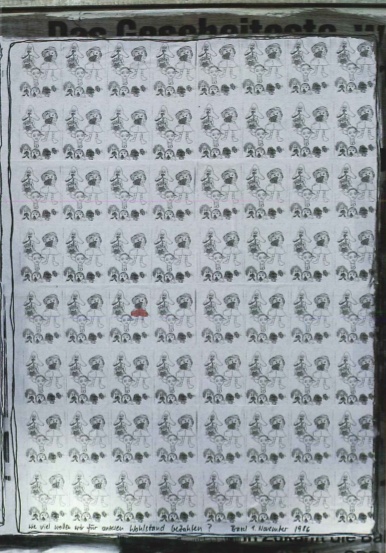
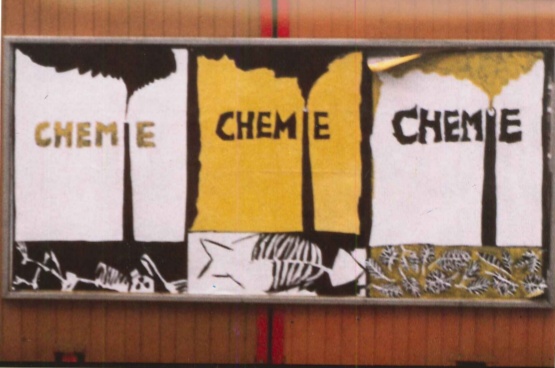
1986 brennt es auf dem Industriegelände Schweizerhalle. Tonnen von Chemikalien landen im Rhein: eine riesige Umweltkatastrophe. Dafür wird das ökologische Bewusstsein der Bevölkerung gestärkt.


Blutrotes Rheinwasser!

(Graffiti) Künstler-innen haben stark reagiert!

1. November 1986 in Schweizerhalle

Das grosse Feuer in der 1350 Tonnen Chemikalien enthaltenden Lagerhalle, der dicke Rauch, der Gestank und die unbekannte Zusammensetzung der Verbrennungsgase veranlassten die Behörden der Nachbargemeinden (u. a. Basel), die Bevölkerung frühmorgens mit allgemeinem Sirenenalarm zu alarmieren, auch wurde eine mehrstündige Ausgangssperre verhängt. Menschen erlitten keine akuten Schäden, mit Ausnahme von drei Personen mit vorbestehendem Asthma, die Hospitalisierung benötigten. Jedoch verseuchte Löschwasser den Rhein und löste ein grosses Fischsterben aus. Die Giftwelle, insbesondere Pestizide wie Disulfoton, Thiometon, Parathion oder Fenitrothion mit einer Halbwertszeit von 30 bis 50 Tagen, löschte auf einer Länge von 400 km die gesamte Aalpopulation aus.

Plakataktion unmittelbar nach der Katastrophe


13 February 2018

Dr Great Art Podcast Episode 30: Trope and Metaphor


Dr Great Art podcast, Episode 30: Trope and Metaphor. A podcast in preparation for discussions of visual metaphor: one aspect of terminology, trope and metaphor. iTunes, Spotify, or http://drgreatart.libsyn.com/episode-30-trope-and-metaphor #arthistory #metaphor

---------------------------

Dr Great Art Podcast 30

Trope and Metaphor

Hi this is Mark Staff Brandl, with the 30th "Dr Great Art" brief podcast. I hope you enjoy it and come back for each and every one.

I likely will be discussing Visual Metaphor in Art more and more frequently in future podcasts. This is because it will be returning to a preeminent position within my thoughts. I have a contract for a book with the wonderful Bloomsbury Academic Press and their Analytic Aesthetics and Contemporary Art Series edited by Tiziana Andina and David Carrier. The working title for my book is Visual Metaphor in Contemporary Art and Analytic Philosophy. Thus, I will be writing it while doing future podcasts.

I am particularly interested in receiving and discussing YOUR, my listeners' and friends,' ideas concerning visual metaphor in fine art. It is usually studied, if at all, in posters, popular media ad campaigns, and the like. I am interested in sophisticated, complex and original uses of visual metaphor in contemporary art including but not limited to painting, sculpture, installation, comics and so on.

First, though, is this podcast concerning one aspect of terminology.

TROPE AND METAPHOR

I will often be using the term trope in my podcasts when figurative language in general is meant ---- and especially when discussing the visual equivalent of this. Metaphor is one usual term for the idea which is discussed here. Unfortunately, though, this word is used in two distinct applications, one general and one particular. Confusion often results from this failure to distinguish the species from the genus. Metaphor may mean alternately either figurative expression itself, the genus, therefore identical with figurative language or trope, OR that particular instance thereof, the species, usually described as follows:

Metaphor: A figure of speech, an implied analogy in which one thing is imaginatively compared to or identified with another, dissimilar thing. In metaphor, the qualities of something are ascribed to something else, qualities that it ordinarily does not possess (as Kathleen Morner and Ralph Rausch describe it in their NTC's Dictionary of Literary Terms).

That is, the famous description of metaphor as a "comparison without a like or as," which is always taught in high school and secondary school literature classes. The most famous of these is "Achilles is a lion."

Useful terminology does not allow a thing to be a species of itself. So using the word metaphor is laden with difficulties. Other terms bring other difficulties, all probably reflecting the various underlying philosophies of the animal under study. Various general terms include trope, figure and figurative language. The latter two would cause a problem when the theory is applied to visual art. Anything containing the word language is not interdisciplinary enough and figure in visual art is widely used to mean the human form (e. g. "figure painting").

These terms are inadequate in reference to literature and visual art anyway. They clearly reinforce views of the subject opposite to those I espouse. Connotations such as figure skating or ornateness come to mind, declaring metaphor to be no more than decorative fancy, a kind of sport. (Nothing against THAT, but not anything near my interpretation of metaphor.) There are linked terms such as scheme, conceit, symbol, rhetoric, poesy, poetics, analogy, etc. Yet each expresses a particular idea somewhat askew of my intentions and my own theoretical interests. In fact, as my metaphor(m) or central trope theory comes ever more to the fore, I believe it will be shown that some of these terms describe ideas which are corollaries or particular instances of metaphor(m). They will each be addressed in the future.

In short, the problems with the term reflect old, deficient and competing theories of the thing itself. HOWEVER, I will NOT be using trope in the way it is often now misused in the artworld to mean clichéd symbol! Trope, is an older umbrella term for all rhetorical analogies (metaphor, metonymy, litotes, etc.) One which I have revived. All the arts, probably all thought, is based in tropaic thought. If you are really looking for a term for a "commonplace notion not often recognized as such," then you probably mean topos (plural topoi) NOT trope.

Trope is derived from turning, which might suggest that analogies of any sort are decorative twists on normal "transparent" speech. However, it seems that trope and its concomitant adjectives tropological or tropaic are the most promising. Turning can be envisioned in other, more evocative images and analogies. Turning something around to perceive more sides of it. Turning something toward the light to see it better. And so on.

Therefore it will serve as the general term, metaphor will be chiefly used in its specific application ("no like or as" species), occasionally substituting for the general, along with the other terms mentioned, where this occurs in common use and for stylistic variety. Metaphor is included in the title of our website, my dissertation and my book title for the word play as noted in my theory of metaphor(m) [spell], and because it remains an important keyword in any literature search of poetics.

MORE IMPORTANTLY, in addition, cognitive science, especially pragmatic, embodied cognitive theory, now envisions metaphor as the broad basis of thought itself. Generally when I am talking about metaphor here, I mean the process of making embodied visual analogies. When I mean all the possible forms of this, I will write trope. When I mean a specific form (such as in the paper I posted online recently, "Beyond Like and As in Images: Metonymy and Metaphor in Some Recent Art"), I will use the appropriate specific term from rhetoric, explaining it and why I am using it.

These include: Trope, Metaphor, Metonymy, Simile, Synecdoche, Litotes, Hyperbole, Irony, Analogy, Allegory, Symbol, Metalepsis. More about them in the future.

Thanks for listening. Podcast number 30.

Trope and Metaphor

If you enjoy my podcasts, please go to Apple podcasts and give me 5 stars and a recommendation! It helps others find this podcast. Additionally, if you have any questions or requests for topics, please feel free to contact me with them! I'd truly enjoy covering them! Especially about visual metaphor!

If you wish to hear more cool, exciting and hopefully inspiring stuff about art history and art, come back for more. Also I, Dr Mark Staff Brandl, artist and art historian, am available for live custom Performance-Lectures. In English und auf Deutsch.

I take viewers inside visual art and art history. Entertainingly, yet educationally and aesthetically, I analyze, underline, and discuss the reasons why a work of art is remarkable, or I go through entire eras, or indeed through the entirety of art history, or look at your desired theme through the lens of art history. The lectures often take place with painted background screens and even in my painting-installations.

Some recent ones were on the entire history of Postmodernist Art from 1979 through today, on Metaphor(m) in Art History, and on Mongrel Art. Once again, I'd like to thank Chloe Orwell, Brad Elvis, and the rock band the Handcuffs for composing, performing and recording my theme song, "Shut Up and Paint," a tiny portion of which begins and ends every Dr Great Art Podcast.

You can find or contact me at
www.drgreatart.com/ (spell)
book me at www.mirjamhadorn.com (spell)
or find me on Facebook, Twitter, Instagram, all as Dr Great Art.


27 January 2018

Dr Great Art Podcast Episode 29: 7 Fun Art Artecdotes


The newest Dr Great Art podcast, Episode 29: 7 Fun Facts in Art History. A lighter episode relating seven stimulating facts about Vincent van Gogh, Leonardo da Vinci, Michelangelo and Georgia O'Keeffe. At Apple Podcasts, Spotify or
http://drgreatart.libsyn.com/episode-29-7-fun-facts-in-art-history
#arthistory

Dr Great Art Podcast 29: 7 Fun Artecdotes

Hi this is Mark Staff Brandl, with the 29th "Dr Great Art" brief podcast. I hope you enjoy it and come back for each and every one.

After a series of rather resolutely critical podcasts, today my episode will be a string of more congenial artecdotes, 7 fun facts.

So let's get right into it.

First, Vincent van Gogh's name is strange to pronounce. We all do it wrong. Ask any speaker of Dutch. It is "van Go" to you Americans and French, "van Gof" to you Brits, and something like "fan Chhhochhh" really. We art historians have settled on the German version, which is about half right and not impossible for most of us: "fan Gochhhh."

Second, Vincent produced more than 2,000 works during his life: 900 paintings and 1,100+ drawings and sketches. He probably only sold one painting while he was alive, The Red Vineyard at Arles of 1888. Anna Boch, a Belgian artist, bought the painting in early 1890 for 400 Belgian francs. (I really like her own Pink and Yellow Houses painting, by the way.)

Third, van Gogh didn't even begin art until he was twenty-seven years old, died when he was thirty-seven, and the most important paintings were largely the ones in the two years before he died. He was almost entirely self-taught, an autodidact, and the speed at which he became so great and so independently original in his art is astounding. Especially in the face of being for the most part ignored.

Fourth, Leonardo da Vinci's name is NOT 'da Vinci' !
Leonardo's full name at birth was simply 'Leonardo.'

As an illegitimate child, the son of a notary and a serving girl Caterina (seen as and possible really was something like a slave). His father Piero took him away from his mother and rather ignored him, but nevertheless Leonard could then sign his name Leonardo di Ser Piero.

Leonardo was born just outside the tiny hamlet of Vinci. So people would sometimes tack his origin onto his name: "of Vinci." Leonardo di Ser Piero da Vinci. But that was not a name --- it would be like calling me "of Chicago" or " of Peoria" instead of 'Brandl.' And thus, the 'da' is not capitalized as well.

As he considered Florence to be his real hometown, the artist himself often signed his name "Leonardo the Florentine" or Leonardo the Florentine, the painter." 'Leonardo Fiorentino Pittore.'

Leonardo had twelve half-siblings, who ignored him and caused him difficulty in a dispute over his small inheritance. Yet later, after his great fame, after his death, parts of the family apparently took his place designation as a family name, thus there are "da Vincis" in Italy now. The Renaissance, by the way, was the time in Europe when surnames were being created.

In art historical circles he is simply called 'Leonardo.' Any other Leonardo needs a surname, yes, even "DiCaprio." There is only one, great "Leonardo." On the street, you can say "da Vinci" but never to an art historian.

Fifth, Michelangelo HAD a surname! 'Buonarroti' --- or in full Italian-style 'Michelangelo di Lodovico Buonarroti.'

He is, however, as is well-known, SO important that he is simply called 'Michelangelo.' Which should be pronounced with a short 'i', thus Michelangelo, not 'Michael-Angelo,' but as with 'da Vinci,' on the street we can accept that. Maybe.

In his lifetime, Michelangelo was often called Il Divino ("the divine one"), as even then, and for about 600 years afterwards he has been immensely revered. That has even made the Church nervous on occasion, as Michi is, in a way, we artists' and art historians' chosen saint.

Sixth, while we are on the subject of names, Pablo Picasso was baptized 'Pablo Diego José Fransisco de Paula Juan Nepomuceno María de los Remedios Cipriano de la Santísima Trinidad Martyr Patricio Clito Ruiz y Picasso.' In Spanish style the last two words are the father's surname, the 'y' for 'and,' and then the mother's surname. So he would be Senior Ruiz. But he took his mother's family name alone in France, supposedly because it was less common, but we also know that he had serious difficulties with his father.

Seventh, not everyone needs a huge studio. Although I usually do. Georgia O'Keeffe's most unique one was a car! When she lived in the Southwest of the US, she removed the driver's seat of her Model-A automobile, unbolted the passenger seat, and turned it around to face the back seat. She put canvases on the back seat and painted. The car's limited space seems to have appealed to her because it helped further concentration, shaded her from the heat, and protected her from bothersome bees.

Thanks for listening. Podcast number 29.

7 Fun Artecdotes

If you enjoy my podcasts, please go to Apple podcasts and give me 5 stars and a recommendation! It helps others find this podcast. Additionally, if you have any questions or requests for topics, please feel free to contact me with them! I'd truly enjoy covering them!

If you wish to hear more cool, exciting and hopefully inspiring stuff about art history and art, come back for more. Also I, Dr Mark Staff Brandl, artist and art historian, am available for live custom Performance-Lectures. In English und auf Deutsch.

I take viewers inside visual art and art history. Entertainingly, yet educationally and aesthetically, I analyze, underline, and discuss the reasons why a work of art is remarkable, or I go through entire eras, or indeed through the entirety of art history, or look at your desired theme through the lens of art history. The lectures often take place with painted background screens and even in my painting-installations.

Some recent ones were on the entire history of Postmodernist Art from 1979 through today, on Metaphor(m) in Art History, and on Mongrel Art. Once again, I'd like to thank Chloe Orwell, Brad Elvis, and the rock band the Handcuffs for composing, performing and recording my theme song, "Shut Up and Paint," a tiny portion of which begins and ends every Dr Great Art Podcast.

You can find or contact me at

www.drgreatart.com/ (spell)

book me at www.mirjamhadorn.com (spell)

or find me on Facebook, Twitter, Instagram, all as Dr Great Art.

Dr Great Art Podcast Episode 28: Neo-Sophistry in Art

Dr Great Art podcast Episode 28: Sophistry in Art

This episode concerns a troublesome yet seldom acknowledged tendency in the artworld: Sophistry. Why are you in this struggle? Are you an artist or critic or curator simply for careerist "success"? Weren't you actually CALLED to art?
http://drgreatart.libsyn.com/episode-28-sophistry-in-art
#arthistory #philosophy

Dr Great Art Podcast 28 28

Sophistry, Careerism in Art

Hi this is Mark Staff Brandl, with the 28th "Dr Great Art" brief podcast. I hope you enjoy it and come back for each and every one.

Today my Artecdote concerns a troublesome yet seldom acknowledged tendency I see in the artworld: Sophistry. Or more correctly, (Neo-)Sophistry

There is a new Sophistry now rampant in the world and even in the artworld, where one would least expect it.

What is Sophistry?

The essential claim of sophistry is that the actual validity of an argument is irrelevant (even non-existent); it is only the ruling of the audience which matters --- and usually only the ruling of a "chosen" audience of fellow-believers. Thus any position ruled true by these "judges" must be considered completely correct, even if it was arrived at by naked pandering to prejudices, or even by bribery or by coercion. Critics such as Socrates have, of course, argued that this claim relies on a straw man caricature of logical discourse and is, in fact, a circular, self-justifying act of self-deception and even fawning.

Sophists claim there is no reason to search for or even desire such things as quality, truth, analysis, criticality, social justice, etc. In fact, they claim that there no real knowledge, yet they historically insist on teaching this very "fact" of know-nothing-ism, producing students who excel in memorization, performance, and what we nowadays call yuppie-career-development. Socrates criticized them, noting that they are not concerned to know and teach the way anything might really stand, but only to prevail over others, merely to win, without provoking their listeners to desire anything of importance. Sophists, according to him, are not only ignorant of the essential nature of the phenomena they profess to teach, they practice deception.

In a parallel manner, many of the "powerful" in the artworld of today, even artists themselves, make no claim to any actual desire for anything beyond a rather bovine, suburban, view of career success and are happy to teach this and promote it and themselves in universities, museums, Kunsthallen, exhibitions, biennials and the like. One prominent European curator and art school director has even openly claimed his position as a complete Sophist. Most others in similar positions would deny it, but practice it, which is Sophistry at its most conformist.

Thus Neo-Sophistry is the newest form of an age-old erroneous and self-serving belief, often born of a very middlebrow envy of creativity, deeper intellectual thought or vital desire.

Ask yourself, why are you in this struggle? Are you an artist or critic or curator simply because you were too incompetent to be a success in a "real" career such as banking or popular music or novel-writing or...? I don't think so.

Weren't you actually CALLED to art in some way, by someone?

Think back. Duchamp said that that he wanted to be the "champion of the world or champion of something" yet denied easy success at every turn. He eventually claimed (fallaciously it later was revealed) to have renounced his vocation. Explaining this supposed retreat to his patron Katherine Drier, he wrote: "Don't see any pessimism in my decisions; they are only a way toward beatitude." But actually he was working on his last permanent installation.

The best way toward beatitude lies, though, NOT in denying your vocation, or lying about that, but in remembering and returning to its original roots regularly. That is in order to try to truly be yourself in art, one of THE most difficult of all things. Keep in mind your love of art.

Do not be conformed to this artworld of Neo-Sophistry, but be transformed by the renewing of your mind. Confidence in your calling is your source, not hypocrisy or careerism. These are false gods.

Neo-Sophistry in art is the blind promulgating the mute.

Thanks for listening. Podcast number 28.

Sophistry in Art.

If you enjoy my podcasts, please go to Apple podcasts and give me 5 stars and a recommendation! It helps others find this podcast. Additionally, if you have any questions or requests for topics, please feel free to contact me with them! I'd truly enjoy covering them!

If you wish to hear more cool, exciting and hopefully inspiring stuff about art history and art, come back for more. Also I, Dr Mark Staff Brandl, artist and art historian, am available for live custom Performance-Lectures. In English und auf Deutsch.

I take viewers inside visual art and art history. Entertainingly, yet educationally and aesthetically, I analyze, underline, and discuss the reasons why a work of art is remarkable, or I go through entire eras, or indeed through the entirety of art history, or look at your desired theme through the lens of art history. The lectures often take place with painted background screens and even in my painting-installations.

Some recent ones were on the entire history of Postmodernist Art from 1979 through today, on Metaphor(m) in Art History, and on Mongrel Art. Once again, I'd like to thank Chloe Orwell, Brad Elvis, and the rock band the Handcuffs for composing, performing and recording my theme song, "Shut Up and Paint," a tiny portion of which begins and ends every Dr Great Art Podcast.
You can find or contact me at

www.drgreatart.com/ (spell)

book me at www.mirjamhadorn.com (spell)

or find me on Facebook, Twitter, Instagram, all as Dr Great Art.